Selected piano works Bach‑B6
arranged for organ
- No. 1 Toccata in d minor BWV 913
- No. 2 Prelude and Fugue in b-flat minor BWV 867
- No. 3 Prelude and Fugue in C major BWV 870
- No. 4 Prelude and Fugue in D major BWV 874
- No. 5 Prelude and Fugue in C-sharp major BWV 872
- No. 6 Prelude and Fugue in G major BWV 884
- No. 7 Prelude and Fugue in g minor BWV 885
- No. 8 Prelude and Fugue in B-flat major BWV 866
- No. 9 Prelude and Fugue in c-sharp minor BWV 849
- No. 10 Toccata in D major BWV 912
- No. 11 Fanstasia and Fugue in a minor BWV 904
- No. 12 Toccata in f-sharp minor BWV 910
- No. 13 Toccata in g minor BWV 915
- No. 14 Toccata in c minor BWV 911
- No. 15 Chromatic Fantasia and Fugue in d minor BWV 903
- –
- –
- –
1.
| Reger-Werkausgabe | Bd. III/1: Bearbeitungen für Orgel und Harmonium, S. 34–197. |
| Herausgeber | Christopher Grafschmidt, Claudia Seidl. Unter Mitarbeit von Knud Breyer und Stefan König. |
| Verlag | Carus-Verlag, Stuttgart; Verlagsnummer: CV 52.819. |
| Erscheinungsdatum | September 2025. |
| Notensatz | Carus-Verlag, Stuttgart. |
| Copyright | 2025 by Carus-Verlag, Stuttgart and Max-Reger-Institut, Karlsruhe – CV 52.819. Vervielfältigungen jeglicher Art sind gesetzlich verboten. / Any unauthorized reproduction is prohibited by law. Alle Rechte vorbehalten. / All rights reserved. |
| ISMN | 979-0-007-34478-8. |
1. Genesis
Publication
On 26 January 1901, Reger wrote to Karl Peiser, the publishing director of Hug & Co. in Leipzig, promising “a series of moderately difficult compositions for organ”, and mentioning that he also had “another item for organ […] more or less finished; it’s those Preludes and Fugues from Bach’s ‘Well-Tempered Clavier’ that are suitable for organ (parts I and II). This would surely be a very worthwhile undertaking; I have made every effort to make it as good and practicable as possible. It would make the whole collection about 50–60 pages long. To be sure, some such fugues have already appeared in such an arrangement – but not yet a ‘quasi’ complete edition! Please let me know as soon as possible if you’ll think about it; I can send you this manuscript (after an extensive and thorough check) in 4 weeks”. (Letter from Reger to Karl Peiser of 26 January 1901) We do not know whether Reger actually submitted this collection for publication to Hug, or even just sent it to them to assess it. Reger published arrangements from the Well-Tempered Clavier with Jos. Aibl in 1903 as nos. 2–9 of his Selected Piano Works, and since these pieces amount to 57 printed pages, they could have been the same pieces that he had offered to Hug.
On 3 June 1901, Reger wrote to the critic Theodor Kroyer as follows: “I have now arranged Bach’s Chromatic Fantasy and Fugue for organ, together with another wonderful Toccata and Fugue; I fear in advance that quite a few of our organists will not entirely agree with my ‘impetuous’ conception of Bach’s Chromatic Fantasy and Fugue. But there again, when was Bach ever such a ‘weakling’ in his great piano and organ works, as I have unfortunately often had to hear him played by pianists and organists!” (Letter from Reger to Theodor Kroyer of 3 June 1901) Reger’s manuscript of the Chromatic Fantasy and Fugue BWV 903 (later no. 15) bears the date 20 April 1901 at its close; his arrangement of the Toccata and Fugue from BWV 913 (later no. 1) was probably written straight afterwards. On 15 June, Reger sent the engraver’s copies for these works and several others1 to Jos. Aibl of Munich for publication.2 These Bach arrangements were then published in the second half of April 1902.3 Reger sent out copies to people, including one to the organist Otto Becker4 of Berlin, thanking him a few weeks later “for having performed my edition of the Chromatic Fantasy and Fugue”.5
On 22 April 1902, Reger wrote to Kroyer to say that the Bach arrangements “of which I sent you 2, three days ago, are now a series of 20 numbers! All finished!” (Letter from Reger to Theodor Kroyer of 22 April 1902) It remains unclear as to whether Reger was here including his arrangements from the Well-Tempered Clavier of 15 months earlier (see above). But a little more than three months later, he wrote to Alexander Wilhelm Gottschalg, the editor of the journal Urania, to say that “I have just made organ arrangements of 13 piano pieces by Bach!”6 He probably submitted these thirteen arrangements to Aibl for publication in September 1902.7 It is impossible to say whether or not these thirteen constituted a subset of the twenty arrangements mentioned to Kroyer, or whether they were a replacement for them.
Reger’s source for his arrangements from the Well-Tempered Clavier (nos. 2–9) might have been an edition by Carl Czerny published by C.F. Peters, for he seems to have based his tempi, dynamics and articulation on it for long stretches, at times even adopting them exactly. For Toccatas nos. 13 and 14, it is at least within the realms of possibility that his source could have been a joint edition by Czerny, Friedrich Conrad Griepenkerl and Ferdinand August Roitzsch (also published by C.F. Peters, see Bach-B8). But the question as to his source for the remaining pieces must remain open for the time being (see “Reger’s sources” and the Critical Report).
Reger now gathered together his total of fifteen arrangements, placing the two pieces already published at the top and the bottom of his composite title page. His new arrangements were nevertheless also published by Aibl in individual editions, albeit numbered consecutively as nos. 2–14. They are listed in the May 1903 issue of Hofmeister’s Musikalisch-literarischer Monatsbericht.8 An edition in a single volume, divided into five sections, was presumably only realised after Aibl was taken over by Universal Edition in 1904.
2.
Translation by Chris Walton.
1. Reception
The first two arrangements published (nos. 1 and 15) were at least acknowledged by the critics. Friedrich L. Schnackenberg compared Reger’s versions (“[he is] surely one of the most ideal people for such work”) with an arrangement by Paul Homeyer. (Review) In the Chromatic Fantasy and Fugue in particular, he praised several of Reger’s effective interventions in the expression markings (such as “the stringendi and ritardandi in the broad arpeggio passages”). In Schnackenberg’s opinion, Reger’s decision to entrust the third voice to the pedal was because “this makes the whole much clearer to the eye, and it also makes a far more coherent, unified impression on the ear – assuming that the correct registration is employed”. And Eugen Segnitz offered “special praise and the greatest appreciation for […] the numerous annotations and markings that always hit the mark […] and for which the player has to thank his famous editor”. (Review)
2.
Translation by Chris Walton.
1. Stemma
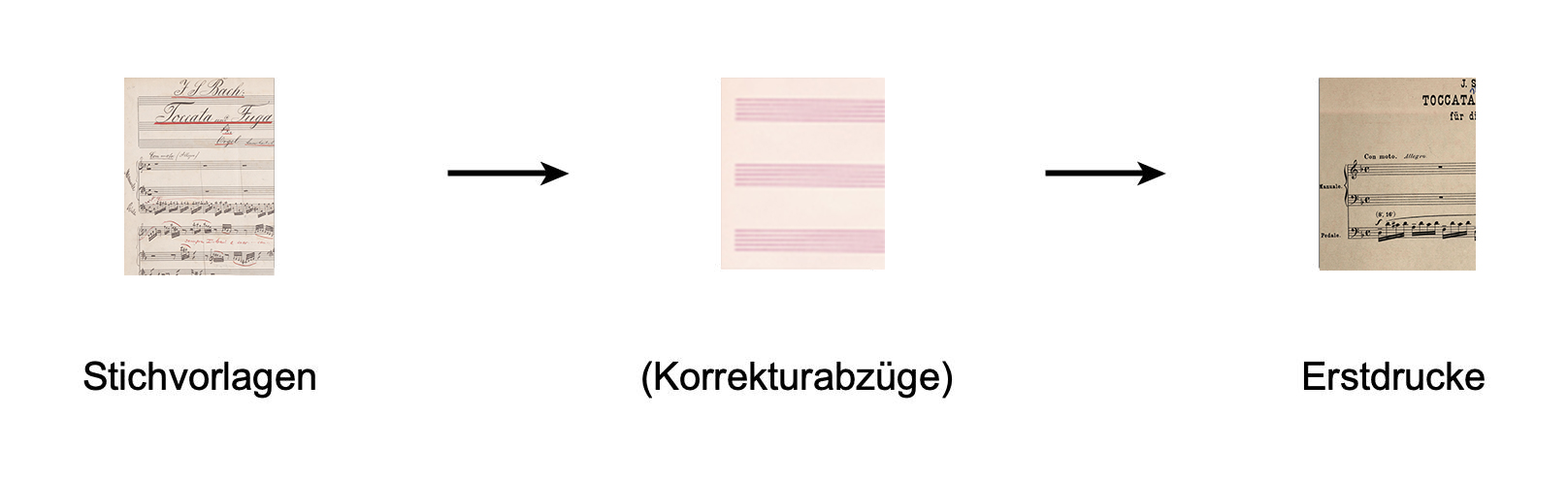
2. Quellenbewertung
Der Edition liegen als Leitquelle die Erstdrucke zugrunde. Als Referenzquelle dienten die Stichvorlagen. In Zweifelsfällen wurden die Quellen der Originalwerke zu Rate gezogen.
3. Sources
- Stichvorlagen
- Erstdrucke Nr. 1 und 15
- Erstdrucke Nr. 2–14
Object reference
Max Reger: Selected piano works Bach‑B6, in: Reger-Werkausgabe, www.reger-werkausgabe.de/mri_work_01186.html, version 4.0, 2nd July 2026.
Information
This is an object entry from the RWA encyclopaedia. Links and references to other objects within the encyclopaedia are currently not all active. These will be successively activated.