Feierlicher Einzug TrV 224 Strauss‑B2
arranged for organ, 2-3 trb (ad lib.) and 3 timp (ad lib.)
- Feierlicher Einzug TrV 224
- –
- –
- –
1.
| Reger-Werkausgabe | Bd. III/1: Bearbeitungen für Orgel und Harmonium, S. 238–242. |
| Herausgeber | Christopher Grafschmidt, Claudia Seidl. Unter Mitarbeit von Knud Breyer und Stefan König. |
| Verlag | Carus-Verlag, Stuttgart; Verlagsnummer: CV 52.819. |
| Erscheinungsdatum | September 2025. |
| Notensatz | Carus-Verlag, Stuttgart. |
| Copyright | 2025 by Carus-Verlag, Stuttgart and Max-Reger-Institut, Karlsruhe – CV 52.819. Vervielfältigungen jeglicher Art sind gesetzlich verboten. / Any unauthorized reproduction is prohibited by law. Alle Rechte vorbehalten. / All rights reserved. |
| ISMN | 979-0-007-34478-8. |
1. Genesis
Publication
On 10 August 1909, right at the beginning of his summer holidays in Kolberg on the Baltic coast (today Kołobrzeg in Poland), Reger responded to a request from Robert Lienau, the owner of the Berlin publishing company Schlesinger’sche Buch- und Musikhandlung: “Of course I’ll arrange Strauss’s march for the organ (with trombones ad libitum);1 since I have the time to do it right now, please send me the march in question as soon as possible”. (Letter from Reger to Robert Lienau of 10 August 1909) Richard Strauss had composed his Feierlicher Einzug (“Solemn entrance”) “back then for Prince Eitel Friedrich when he was made a Knight of St John, in other words for the House of Hohenzollern”.2 The investiture took place on 18 March 1907.3 In 1909, it was decided that the March ought to be published in a revised version, both in its original instrumentation4 and in various arrangements.5
Two days after receiving the score and the piano reduction6 from Lienau that were to serve as his sources for the arrangement, Reger expressed his annoyance to Henri Hinrichsen, the then managing director of the publishing house of C.F. Peters: “Strauß shouldn’t prostitute himself in this way; it’s impossible to assess this shoddy piece of work any other way. Every composer sometimes writes an occasional work – but a man like Strauss should not be allowed to plunge so low!” (Letter from Reger to Henri Hinrichsen probably of 24 August 1909) All the same, Reger fulfilled his lucrative commission7 and sent off his finished arrangement to Lienau on 26 August 1909. “I have understood what you had in mind for this arrangement for organ, and have consequently made of the piece what could best be made of it … at the repeat of the main section I added the ‘introductory fanfares’ as a counterpoint to the march of the main section, which when performed – as intended – will have quite an attractive effect on different manuals.8 I have deliberately saved up the trombones for the end, so that the conclusion can sound as pompous as possible”. (Letter from Reger to Robert Lienau of 26 August 1909)
Reger gleefully reported to Hinrichsen a discovery that he had made: “That business of the march by Richard II (the II here means “second quality”!) has had a wonderful epilogue! In both the piano reduction and the score of this march there are 2 passages that seem absolutely impossible, even to a man with my famously broad conscience in harmonic matters. I informed Schlesinger of this, who replied that he himself had already noticed these 2 passages and had therefore also already contacted Strauß. But he let both passages ‘pass’ without any objection! The situation is now as follows. I promptly wrote to Schlesinger to say that it’s quite impossible for him to publish this march with these 2 passages! Now Schlesinger wants to wait until he can speak with Strauss himself! Isn’t that marvellous???” (Letter from Reger to Henri Hinrichsen of 29 August 1909) We do not know whether or not Reger’s objections had any consequences.
On 1 September 1909, Reger thanked Lienau for his remarkably high fee of 300 marks, and promised to check through “the final proofs before it goes to print”. (Postcard from Reger to Robert Lienau of 1 September 1909) The publication of this work and of its assorted arrangements was listed over several issues of Hofmeisters Musikalisch-literarischer Monatsbericht, including the piano solo version in its September 1909 issue (p. 262), the full score in the November issue (p. 322) and Reger’s arrangement in the issue of March 1910 (p. 67).9
2.
Translation by Chris Walton.
1. Reception
At present, there are no records of performances in Reger's time.
1. Stemma
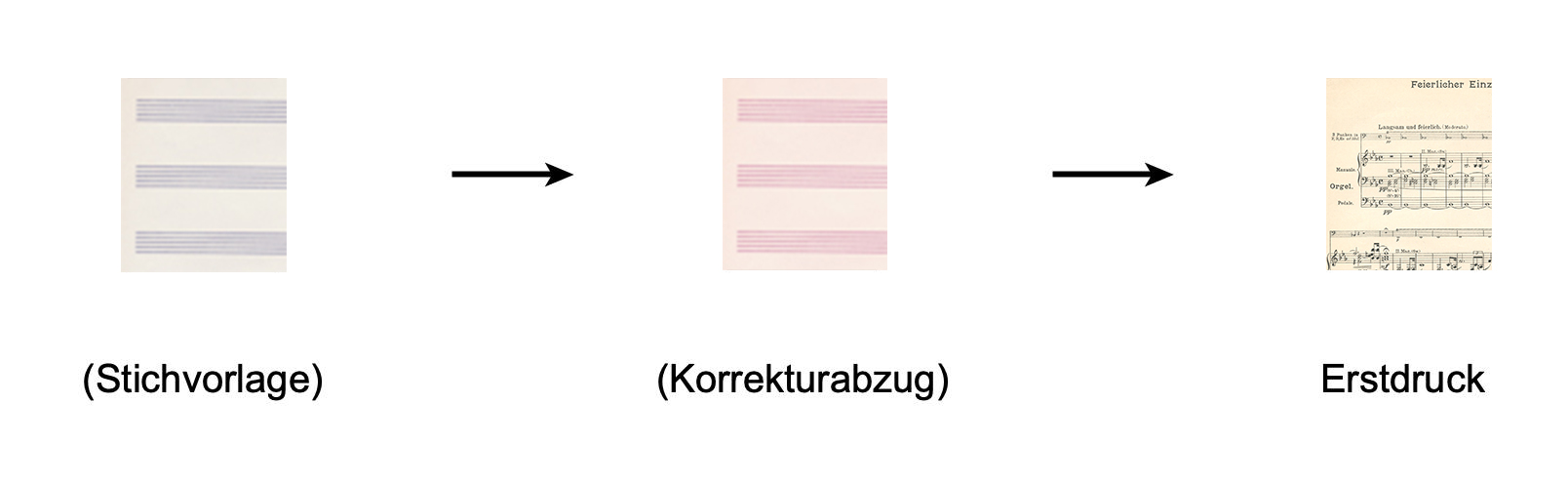
2. Quellenbewertung
Der Edition liegt als Leitquelle der Erstdruck zugrunde. In Zweifelsfällen wurden die Vorlagen zu Rate gezogen.
3. Sources
- Erstdruck
Object reference
Max Reger: Feierlicher Einzug TrV 224 Strauss‑B2, in: Reger-Werkausgabe, www.reger-werkausgabe.de/mri_work_01261.html, version 4.0, 12th June 2026.
Information
This is an object entry from the RWA encyclopaedia. Links and references to other objects within the encyclopaedia are currently not all active. These will be successively activated.