Haus- und Kirchenmusik op. 79
Compositions op. 79g
Three Chorale Arrangements for three-part women’s or children’s unaccompanied choir
-
No. 1 Lobt Gott, ihr Christen, allzugleich!
Text: Nikolaus Herman
-
No. 2 Nun lasst uns gehn!
Text: Paul Gerhardt
-
No. 3 Danksaget dem Vater!
Text: unknown
- Haus- und Kirchenmusik op. 79
Other parts:- Compositions op. 79a for piano
- Compositions op. 79b for organ
- Compositions op. 79c for voice and piano
- Compositions op. 79d for violin and piano
- Compositions op. 79e for cello and piano
- Compositions op. 79f for mixed voice unaccompanied choir
- -
- -
1.
| Reger-Werkausgabe | Bd. II/10: Werke für Männer-, Frauen- und Kinderchor, S. 160–163. |
| Herausgeber | Christopher Grafschmidt und Claudia Seidl. Unter Mitarbeit von Knud Breyer und Stefan König. |
| Verlag | Carus-Verlag, Stuttgart; Verlagsnummer: CV 52.817. |
| Erscheinungsdatum | Oktober 2024. |
| Notensatz | Carus-Verlag, Stuttgart. |
| Copyright | 2024 by Carus-Verlag, Stuttgart and Max-Reger-Institut, Karlsruhe – CV 52.817. Vervielfältigungen jeglicher Art sind gesetzlich verboten. / Any unauthorized reproduction is prohibited by law. Alle Rechte vorbehalten. / All rights reserved. |
| ISMN | 979-0-007-31440-8. |
| ISBN | 978-3-89948-464-9. |
No. 1 Lobt Gott, ihr Christen, allzugleich!
Nikolaus Herman: Nr. 366, in:
Evangelisches Gesangbuch für Elsaß-Lothringen, ed. by Julius Smend and Friedrich Spitta, Leitz und Mündel, Straßburg
Copy shown in RWA: DE, Karlsruhe, Max-Reger-Institut/Elsa-Reger-Stiftung.
Note: Reger hatte das Gesangbuch von Friedrich Spitta, einem der beiden Herausgeber, erhalten.
Note: Erschienen in: Drey geistliche Weynachtlieder vom Newgebornen kindlin Jesu für die kinder im Jochimstal. N. H., Magdeburg? um 1550 (DKL 155001) (RISM – Das deutsche Kirchenlied. DKL. Kritische Gesamtausgabe der Melodien, Bd. 1: Verzeichnis der Drucke von den Anfängen bis 1800, hrsg. von Konrad Ameln, Markus Jenny und Walther Lipphardt, Kassel 1975).
Note: In Karl Christian Thust, Die Lieder des Evangelischen Gesangbuchs (Bd. 1, Kassel 2012, S. 48) wird die im Evangelischen Gesangbuch (und auch bei Reger) angegebene Jahreszahl 1554 auf 1550 korrigiert, jedoch mit dem Hinweis, jene Ausgabe (s. o.) enthalte lediglich vier Strophen. In einem in der Staatsbibliothek zu Berlin – Preußischer Kulturbesitz aufbewahrten Exemplar (dort allerdings auf 1555 datiert) sind jedoch acht Strophen notiert. Diese Fassung sei laut Thust aber erst in Die Sontags Euangelia vber das gantze Jar Jn Gesenge verfasset Für die Kinder vnd Christlichen Haußveter Durch Nicolaum Herman im Jochimsthal (Wittenberg 1560, DKL 156008) enthalten.
No. 2 Nun lasst uns gehn!
Paul Gerhardt: Nr. 28, in:
Evangelisches Gesangbuch für Elsaß-Lothringen, ed. by Julius Smend and Friedrich Spitta, Leitz und Mündel, Straßburg
Copy shown in RWA: DE, Karlsruhe, Max-Reger-Institut/Elsa-Reger-Stiftung.
Note: Reger hatte das Gesangbuch von Friedrich Spitta, einem der beiden Herausgeber, erhalten.
Note: Erschienen in Christoff Runge, D. M. Luthers Vnd anderer vornehmen geistreichen und gelehrten Männer Geistliche Lieder und Psalmen Berlin 1653 (DKL 156301), Nr. 106, S. 157, sowie in Johann Crüger, Praxis pietatis melica, fünfte Auflage, Berlin 1653 (DKL 156304), Nr. 118, S. 215–217. (Karl Christian Thust [Die Lieder des Evangelischen Gesangbuchs Bd. 1, Kassel 2012, S. 58] vermutet es bereits in Crügers “verloren gegangener Ausgabe von 1648” (= DKL 164708), was durch Johann Friedrich Bachmann (Paulus Gerhardts geistliche Lieder, historisch-kritische Ausgabe von D. J. F. Bachmann, Berlin 1866, S. 42 bzw. 99), dem jene Ausgabe noch vorlag, jedoch nicht bestätigt wird.) Johann Friedrich Bachmann schreibt das Lied Gerhardts “Candidatenzeit” (1643–1651) zu bzw. genauer: “Wie V. 3. u. 10. des Liedes deutlich zeigen, ist dasselbe schon unter den Schrecknissen des dreißigjährigen Krieges gedichtet.” (Paulus Gerhardts geistliche Lieder, historisch-kritische Ausgabe von D. J. F. Bachmann, Berlin 1866, S. 42 bzw. 99.)
Note: Reger notierte lediglich die Strophen 1, 2, 6 und 7 des 15-strophigen Gedichts.
Note: Evangelisches Gesangbuch für Elsaß-Lothringen, Straßburg 1899, Nr. 28 (in Takt 2, 4, 6 und 8 der Taktart angepasst, original 3/2 statt 6/4).
No. 3 Danksaget dem Vater!
unknown
Used for comparison purposes in RWA: [Danksaget dem Vater…], in:
Die Bibel oder die ganze Heilige Schrift des Alten und Neuen Testaments. nach der deutschen Übersetzung D. Martin Luthers, 1. Abdruck, ed. by Martin Luther, Halle
Copy shown in RWA: DE, Münster, Universitäts- und Landesbibliothek.
Note: Quelle: Bibel (Kolosser 1, Vers 12/13), Ehre sei Gott in der Höhe u. a.
Note: Welche Auflage der Bibel Reger als Vorlage verwendete ist nicht bekannt.
1. Composition
Publication
From late 1899 onwards, Reger used sheet-music supplements in journals such as the Allgemeine Musik-Zeitung, the Neue Musik-Zeitung, the Musik-Woche, the Blätter für Haus- und Kirchenmusik and the Monatschrift für Gottesdienst und kirchliche Kunst to present himself to a broad public as a composer in all manner of genres (piano pieces, organ works, songs, chamber music and choruses). With just a few exceptions, the works he published thus were composed specifically for these supplements. He later published the works from the Blätter and the Monatschrift under the title Compositions op. 79a–g.
The Monatschrift für Gottesdienst und kirchliche Kunst had been founded in 1896 by Friedrich Spitta and Julius Smend. Reger probably first approached Spitta in the summer of 1899 “with a request to be able to make his works known in Protestant church circles and with an offer to compose something himself for the Monatschrift”.1 On 18 January 1900, Reger submitted a proposal to Smend: “Since I will have more time from the 21st of the month to the 28th, I could very nicely write a 4-page supplement for your highly esteemed ‘Monatsschrift’ (3-part choral pieces) […]! Please let me have some melodies and texts as soon as possible that Your Reverence would especially like to have for 3 voices! I’ve got the Alsatian hymnal (latest edition). […] I have to work furiously until the 21st – but then things will be quieter and I’d like to get down to the 3-part pieces straight away!”2 If Smend did indeed fulfil Reger’s request, then he could have composed his three-part pieces for women’s choir in late January 1900. After two chorale arrangements for mixed choir (later his op. 79f nos. 11 and 14) and a chorale prelude for organ (later his op. 67 no. 48), the December 1900 issue brought Three three-part compositions by Max Reger for Christmas, New Year and Epiphany (on four pages); these later became his op. 79g.
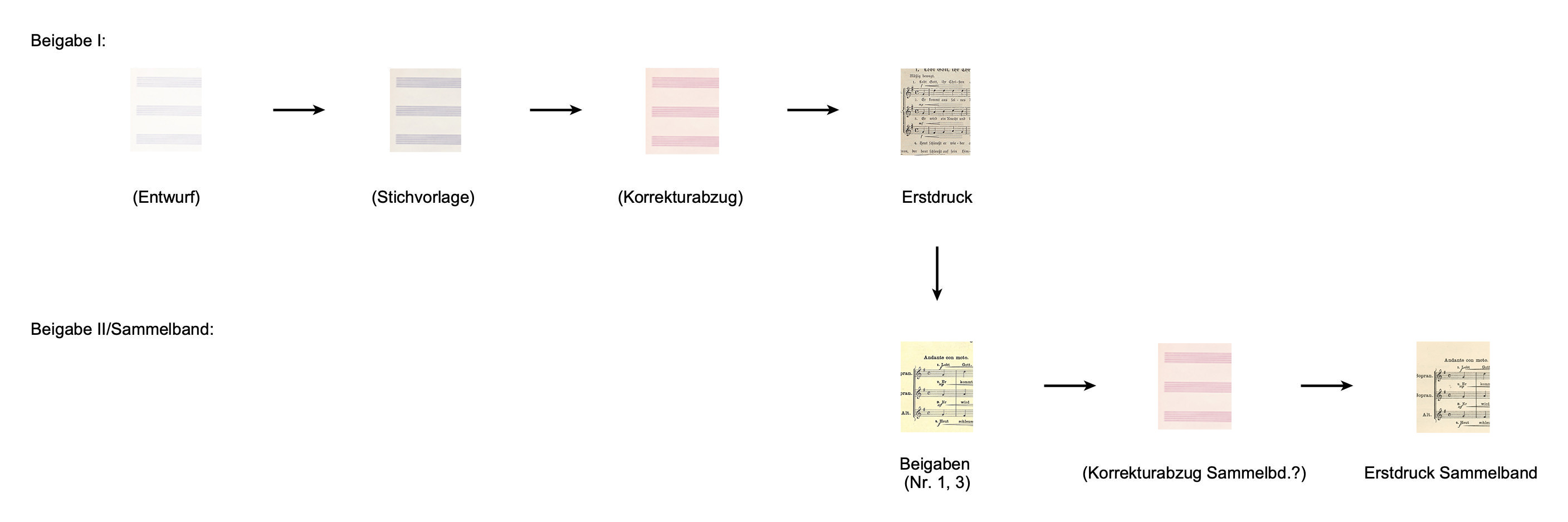
Between December 1900 and September 1902, Reger provided the publisher Beyer & Söhne in Langensalza with 38 small compositions for publication in their Blätter für Haus- und Kirchenmusik. On 9 October 1903, he then sent the journal’s editor, Ernst Rabich, his 15 compositions (including ten choral pieces) that had already been published in the Monatschrift für Gottesdienst und kirchliche Kunst.3 Of his Three three-part compositions, Lobt Gott, ihr Christen, allzugleich (“Praise God, you Christians, altogether”, no. 1) and Danksaget dem Vater (“Give thanks to the Father”, no. 3) were newly engraved and published as supplements in the Blätter in December 1903 and March 1904 respectively; no. 1 was published again in the same manner, seven years later.4
In April 1904, Reger agreed to gather together all his music supplements published by Beyer & Söhne as his opus number 79. He also determined their division into different volumes. But astonishingly, he did not list these choral works in his own overview of his works.5 They were published all the same, but in the case of the first of the two choral volumes, op. 79f (works for mixed choir), its plate number 922 already indicates that it was published a considerable time after the previous volumes (which were published with relatively few gaps between them, with the plate numbers 862–883). Op. 79g even bears the plate number 1009. Regrettably, Reger’s extant correspondence with both the publisher and Rabich provides no reliable information about when the anthology op. 79g was published. One possible indication that it was published later is a request from Reger to Rabich in July 1908 that he should “kindly see to the corrections to the as-yet unpublished compositions that Messrs Beyer + Mann still have from me – because I am too dreadfully busy!”6 What’s more, the same plate that was used in 1903 was used again for the reprint of Lobt Gott in the December 1910 issue, which is why we may assume that the change to the title heading (with numbering, but without indicating the scoring) and the plate number for the anthology were only made afterwards. Hofmeister’s Musikalisch-literarischer Monatsbericht is only of limited help to us here, because Beyer & Söhne evidently only reported its new publications collectively and at intervals of several months or even years. Thus both choral volumes were only listed in the January 1914 edition of the Monatsbericht.7
Several changes were made to the editions that Beyer & Söhne published. The scoring – which in the supplements to the Monatschrift was given only as soprano I and II and alto – was stated as three-part women’s or boys’ choir when the pieces were published in the supplements to the Blätter and in the anthology. When Reger sent the supplements to Rabich, however, he had given the alternative ensemble as “children’s choir”, not “boys’ choir”.8 On its title page, the anthology describes its content as “three chorale arrangements”, which is not correct, because Danksaget dem Vater is an “original composition”9 by Reger. In the supplement to the Monatschrift, these three chorale settings are arranged according to the ecclesiastical year, but in the anthology their order has been changed to 1, 3, 2, possibly for purely practical reasons because it means one does not have to turn the page during performance. In Reger’s accompanying letter of October 1903, these three pieces are listed in their original order.10 In Lobt Gott, two changes were made to the alto part in the editions published by Beyer & Söhne (both in the Blätter and the anthology) compared to the version in the Monatschrift. The second of these changes (in measure 9), which seems unnecessary, results in ungainly part-writing (in Danksaget dem Vater, measure 27, the same turn of phrase remains untouched).
There is no proof of Reger having been involved in the various editions of these three choral pieces published by Beyer & Söhne. The RWA therefore bases its edition on the music supplement published in the Monatschrift für Gottesdienst und kirchliche Kunst.
2.
Translation by Chris Walton.
1. Reception
At present, there are no records of performances in Reger's time.
1. Stemma
2. Quellenbewertung
Eine Beteiligung Regers am Neudruck von Nr. 1 und 3 als Zeitschriftenbeigabe sowie an der Ausgabe der Chöre als Sammelband Opus 79g lässt sich nicht nachweisen. Daher liegt der Edition als Leitquelle der Erstdruck als Zeitschriftenbeigabe zugrunde.
3. Sources
- Zeitschriftenbeigabe: Erstdruck
- Zeitschriftenbeigabe: Neudruck Nr. 1 und 3 (1903/04)
- Zeitschriftenbeigabe: Titelauflage Nr. 1 (1910)
- Sammelband: Erstdruck
Object reference
Max Reger: Compositions op. 79g, in: Reger-Werkausgabe, www.reger-werkausgabe.de/mri_work_00092.html, version 3.1.5, 28th November 2025.
Information
This is an object entry from the RWA encyclopaedia. Links and references to other objects within the encyclopaedia are currently not all active. These will be successively activated.