Schule des Triospiels Bach‑B8
arranged for organ
- No. 1 Invention no. 1 in C major BWV 772
- No. 2 Invention no. 2 in c minor BWV 773
- No. 3 Invention no. 3 in D major BWV 774
- No. 4 Invention no. 4 in d minor BWV 775
- No. 5 Invention no. 5 in E-flat major BWV 776
- No. 6 Invention no. 6 in E major BWV 777
- No. 7 Invention no. 7 in e minor BWV 778
- No. 8 Invention no. 8 in F major BWV 779
- No. 9 Invention no. 9 in f minor BWV 780
- No. 10 Invention no. 10 in G major BWV 781
- No. 11 Invention no. 11 in g minor BWV 782
- No. 12 Invention no. 12 in A major BWV 783
- No. 13 Invention no. 13 in a minor BWV 784
- No. 14 Invention no. 14 in B-flat major BWV 785
- No. 15 Invention no. 15 in b minor BWV 786
- –
- –
- –
1.
| Reger-Werkausgabe | Bd. III/1: Bearbeitungen für Orgel und Harmonium, S. [199]–236. |
| Herausgeber | Christopher Grafschmidt, Claudia Seidl. Unter Mitarbeit von Knud Breyer und Stefan König. |
| Verlag | Carus-Verlag, Stuttgart; Verlagsnummer: CV 52.819. |
| Erscheinungsdatum | September 2025. |
| Notensatz | Carus-Verlag, Stuttgart. |
| Copyright | 2025 by Carus-Verlag, Stuttgart and Max-Reger-Institut, Karlsruhe – CV 52.819. Vervielfältigungen jeglicher Art sind gesetzlich verboten. / Any unauthorized reproduction is prohibited by law. Alle Rechte vorbehalten. / All rights reserved. |
| ISMN | 979-0-007-34478-8. |
1. Genesis
Publication
From January 1900 onwards, Reger was busy planning a pedagogical work for pedal playing on the organ (RWV Anhang-B10), initially in collaboration with Gustav Beckmann, then with Karl Straube, intended for publication by Hug & Co. But when work on it came to a standstill,1 Reger turned in February 1903 to an alternative project, about which he wrote as follows to the critic Theodor Kroyer: “I am currently busy with a ‘curious’ thing: A tutor for trio playing for the organ! In other words, I’m composing a third part for J.S. Bach’s 2-part Inventions [BWV 772–786], with the original soprano part in the right hand on the first manual, the original bass part in the pedal2 and an additional part I’m composing for the left hand on the second manual! I want to do a similar thing with the 3-part Inventions [BWV 787-801]!”3 Reger thereby took up once more a procedure that he had already employed back in Wiesbaden, where he had composed a violin part to sonatinas by Muzio Clementi (Clementi-B1 and -B2) and for the first movement of Wolfgang Amadeus Mozart’s Sonata K. 545 (Mozart-B1), all for pedagogical purposes. Reger also on occasion composed an extra part in his Bach arrangements B3 (1895) and B6 (1901–1902) (see above, “Reger and …”).
The source for Reger’s Schule des Triospiels was presumably the edition of Bach’s keyboard works by Carl Czerny, Friedrich Conrad Griepenkerl and Ferdinand August Roitzsch (see Bach-B6), as he seems to have adopted numerous tempo indications, dynamic markings and articulation from it.
Reger must have offered this work to his principal publisher, the recently founded Lauterbach & Kuhn.4 Karl Straube was working for them as a consultant at the time and will surely have been informed of Reger’s plans. However, he initially seems not to have been convinced as to the tutor’s viability and probably advised in advance against its publication before having actually seen it. But Reger’s publishers clearly still wanted to see the manuscript, because Reger sent them the engraver’s copy on 3 May 1903 with the words: “Since you do not want this work, I very much request that you should return it to me very soon; I will then pass it on, because there is a publisher who has been asking me for something for a long time!” (Letter from Reger to Lauterbach & Kuhn of 2–3 May 1903) Lauterbach & Kuhn then sent the manuscript on to Straube for his opinion. One month later, he agreed that it should be published, much to Reger’s satisfaction. “Actually, I am a little ‘triumphant’ that friend Straube […] has now given his warmest recommendation, deeming this an excellent tutor!” (Letter from Reger to Lauterbach & Kuhn of 9 June 1903) Straube’s cooperation was clearly important to Reger on strategic grounds, and it was in this context – and in light of the fact that this new project essentially nullified his former ideas for a pedal tutor – that Reger proposed the following to his publisher: “[I have] one condition that is actually in your interest: the name Karl Straube has to appear on the title page as well as mine; it can only be of the greatest benefit to you if the Schule des Triospiels appears as a joint publication by Straube and myself!” (Ibid.) Reger also emphasised his conviction that “pedal studies involving this kind of trio playing […] will prove to be the right means of awakening and strengthening one’s sense of polyphony, which is the innermost lifeblood of a true organ style”. His technical goal, he said was “achieving absolute independence of the two hands, both from each other and from the playing of the pedals”.5
By late June, however, Straube still had not completed his task of entering the fingerings and pedalling marks and adding an explanation of them to Reger’s prefatory note.6 We do not know which copy Straube was supposed to annotate; it was presumably a copy of the initial proofs. Since Reger’s query to Lauterbach of mid-July about the current state of things was worded rather calmly,7 we may assume that the publication process was well underway at this time. From 27 July onwards, he began to ask for the proofs with his usual sense of urgency, receiving the first instalment on 8 August when he was at his holiday home near Berchtesgaden.8 He must have received the rest of the proofs a few days later;9 both instalments now also contained Straube’s pedal markings and fingerings. Reger was at this time very busy working on the archives of Hugo Wolf that Lauterbach & Kuhn had acquired, and was only able to return the corrected proofs by 8 September. He asked for them “to be given to Mr Straube as soon as possible […]; please give the proofs to the engraver’s only after Mr Straube has checked through these proofs, and then send me a new set of proofs in which all the mistakes have been corrected”. (Reger’s postcard to Lauterbach & Kuhn of 8 September 1903) He finally sent the last proofs back on 11 October.10 The first print was published in December 1903.11
2.
Translation by Chris Walton.
1. Early reception
For Walter Fischer, “this unprepossessing yet so difficult task was a trial of strength for Reger’s immense talent”. (Review) Roderich von Mojsisovics was similarly enthusiastic about this “curiosity”: “In pedagogical terms we can deem this idea to be well-nigh ideal”. (Review) Robert Frenzel pointed out that “these masterly trios” might “also find excellent use in church services and organ recitals” (Review), while Georg Stolz declared this edition simply “the best among the technical tutors” (Review). Looking back a year after Reger’s death , Joseph Messner found that with this “tutor […] [Reger] did not merely want to offer an example of counterpoint or to set technically difficult tasks, but was really working as an artist to spread out a highly fragrant veil of delicate poetry over Bach’s Inventions”. (Article)
It was Fritz Jöde who was the first to take a more critical view of the whole endeavour. He asked himself “whether such a ‘technical’ task really does a service to the actual essence of music”. For him, Bach’s two parts formed a unity similar to “when two people converse with each other”, and he continued: “when their questions and answers go back and forth from one to the other, [it] is utterly impossible for a third person to keep butting into the conversation”.1 The reviewer of the Musical Standard offered a considerably more sober opinion on the matter: “Purists may dislike this, and there is much to be said from their point of view, but after all, the book is a school and at that an admirable one. Its usefulness justifies it, and above all, the thing is well done, which is the most essential point”. (Review)
2.
Translation by Chris Walton.
1. Stemma
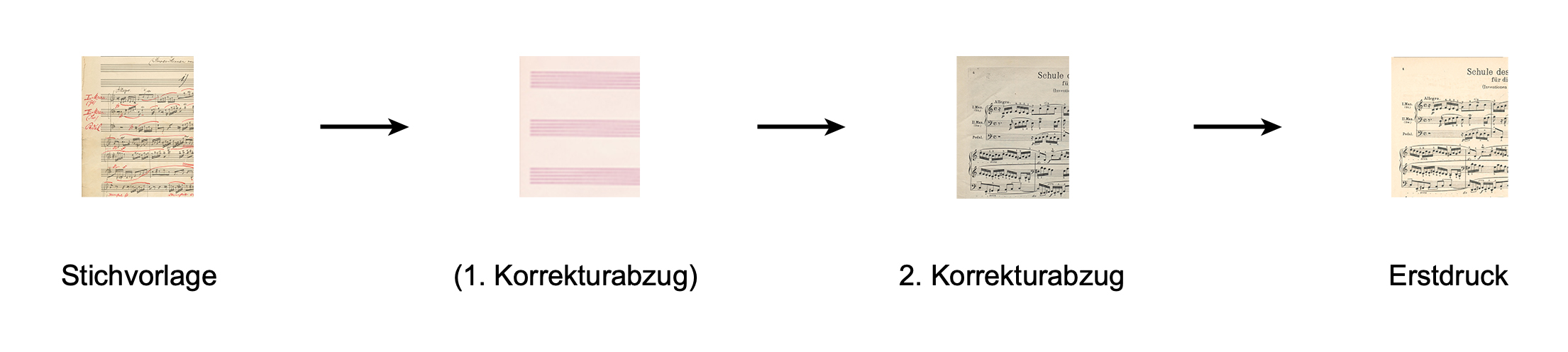
2. Quellenbewertung
Der Edition liegt als Leitquelle der Erstdruck zugrunde. Als Referenzquelle dienten die Stichvorlage und der 2. Korrekturabzug. In Zweifelsfällen wurde die Vergleichsausgabe zu Rate gezogen.
3. Sources
- Stichvorlage
- Korrekturabzug
- Erstdruck
Object reference
Max Reger: Schule des Triospiels Bach‑B8, in: Reger-Werkausgabe, www.reger-werkausgabe.de/mri_work_00707.html, version 4.0, 2nd July 2026.
Information
This is an object entry from the RWA encyclopaedia. Links and references to other objects within the encyclopaedia are currently not all active. These will be successively activated.