Preludes and Fugues from the Well-Tempered Clavier Bach‑B3
arranged for organ
- No. 1 Fugue in E major BWV 878
- No. 2 Prelude in F major BWV 880
- No. 3 Prelude and Fugue in f minor BWV 857
- No. 4 Prelude and Fugue in f minor BWV 857
- No. 5 Prelude in G major BWV 860
- No. 6 Prelude and Fugue in G major BWV 884
- No. 7 Fugue in a minor BWV 889
- No. 8 Prelude and Fugue in B-flat major BWV 866
- No. 9 Fugue in B-flat major BWV 890
- No. 10 Prelude and Fugue in b-flat minor BWV 867
- No. 11 Prelude and Fugue in b-flat minor BWV 867
- No. 12 Fugue in b-flat minor BWV 891
- –
- –
- –
1.
| Reger-Werkausgabe | Bd. III/1: Bearbeitungen für Orgel und Harmonium, digitaler Anhang. |
| Herausgeber | Christopher Grafschmidt, Claudia Seidl. Unter Mitarbeit von Knud Breyer und Stefan König. |
| Erscheinungsdatum | September 2025. |
| Notensatz | Max-Reger-Institut, Karlsruhe. |
| Copyright | 2025 by Max-Reger-Institut, Karlsruhe. Alle Rechte vorbehalten. / All rights reserved. |
1. Genesis
Already back in 1890, the first year of his studies with Hugo Riemann, Reger had begun an intensive study of Johann Sebastian Bach’s Well-Tempered Clavier. His teacher was at the time busy with his analysis of the work1 and had already published an “edition with phrasing” of it.2 But apart from being aware of his teacher’s endeavours, Reger was also making a practical exploration of the work: “He [Riemann] is pleased that I want to play the Well-Tempered Clavier, and he will begin working on it with me next week”. (Letter from Reger to Adalbert Lindner of 11 April 1890) Reger began arranging Bach’s organ works for piano in 1893,3 and on 5 March 1895 he reported to Adalbert Lindner that he was now in the process of “transcribing for organ a large number of Preludes and Fugues from Bach’s Well-Tempered Clavier”. (Letter from Reger to Adalbert Lindner of 5 March 1895) However, this set has only survived in fragmentary form. Apart from tempo indications, it lacks all expression markings (Reger’s “red layer”), nor have all the pieces been preserved complete.
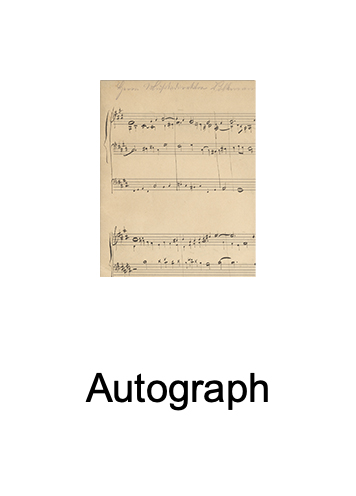
The autograph comprises 48 pages; there are twelve extant, unpaginated double leaves placed one in the other and the arrangements are notated in sequence, from beginning to end. We are thus not dealing with separate manuscripts that have been subsequently collated to form a larger collection. In only two cases has Reger kept the original combination of Prelude and Fugue (in f minor, BWV 857 and b-flat minor, BWV 867). In two others, he has combined different preludes (in G major: Prelude BWV 860 + Fugue BWV 884; in B-flat major: Prelude BWV 866 + Fugue BWV 890). The Prelude in F major BWV 880 is not followed by a corresponding fugue,4 while the Fugue in b-flat minor BWV 891 is not preceded by a prelude.5 This collection comes across as experimental in its organisation. Ulrich Walther sees it as a “regrouping that has been consciously undertaken”.6 It begins in its extant state with the Fugue in E major BWV 878, though only at measure 23; we may assume that this fugue was to be preceded by a prelude. At the centre of the collection, the last twelve measures are missing of the Fugue in G major BWV 884 (fol. 12v), while on the opposite page (fol. 13r), the Fugue in a minor BWV 889 only begins at measure 5. Here, too, we may assume that the fugue was preceded by a prelude. The surviving autograph ends with just under half of the Fugue in b-flat minor BWV 891, so it is conceivable that at least three double leaves are missing on the outside of this autograph (a prelude, then the beginning of the Fugue in E major, then the second half of the Fugue in b-flat minor) and at least two such leaves on the inside (the end of the Fugue in G major, a prelude and the first measures of the Fugue in a minor). The original sequence of pieces could therefore have looked as follows:
- [Prelude in E major]
- Fugue in E major BWV 878
- Prelude in F major BWV 880
- Prelude and Fugue in f minor BWV 857
- Prelude in G major BWV 860
- Fugue in G major BWV 884
- [Prelude in a minor]
- Fugue in a minor BWV 889
- Prelude in B-flat major BWV 866
- Fugue in B-flat major BWV 890
- Prelude and Fugue in b-flat minor BWV 867
- Fugue in b-flat minor BWV 891
Even though Reger never mentioned this collection again, he must have taken the manuscript with him from Wiesbaden to Weiden, where at some point unknown to us he left it with his sister Emma. In 1929, she gave it to Rudolf Volkmann, the Music Director of Jena University.7
In August 1898, according to a letter from Reger to the Wiesbaden music dealer Ernst Guder, he had “also […] completed an arrangement for organ of suitable Preludes and Fugues from the Well-Tempered Clavier; there are 156 pages of them”. (Letter from Reger to Ernst Guder of 16 August 1898) It is impossible to say to what extent that arrangement was based on the Wiesbaden fragment, since the autograph is no longer extant. The arrangements of selected piano works by Bach that Reger made in Munich in 1901/02 (see Bach-B6) also contain the Fugue in G major BWV 884, the Prelude in B-flat major BWV 866 and the Prelude and Fugue in b-flat minor BWV 867, though these reveal a different approach on Reger’s part (for example, the pedal tends to be notated an octave lower).
Our edition of this fragment appears as a digital appendix to the RWA.
2.
Translation by Chris Walton.
1. Reception
At present, there are no records of performances in Reger's time.
1. Stemma
2. Quellenbewertung
Der Edition liegt als Leitquelle das Autograph zugrunde. In Zweifelsfällen wurden die Quellen des Originalwerks zu Rate gezogen.
3. Sources
- Autograph (Fragment)
Object reference
Max Reger: Preludes and Fugues from the Well-Tempered Clavier Bach‑B3, in: Reger-Werkausgabe, www.reger-werkausgabe.de/mri_work_01182.html, version 4.0, 2nd July 2026.
Information
This is an object entry from the RWA encyclopaedia. Links and references to other objects within the encyclopaedia are currently not all active. These will be successively activated.