Legend “St. Francis of Paola walking upon the waves” Liszt‑B1
arranged for organ
- Legend “St. Francis of Paola walking upon the waves”
- –
- –
- –
1.
| Reger-Werkausgabe | Bd. III/1: Bearbeitungen für Orgel und Harmonium, S. 16–32. |
| Herausgeber | Christopher Grafschmidt, Claudia Seidl. Unter Mitarbeit von Knud Breyer und Stefan König. |
| Verlag | Carus-Verlag, Stuttgart; Verlagsnummer: CV 52.819. |
| Erscheinungsdatum | September 2025. |
| Notensatz | Carus-Verlag, Stuttgart. |
| Copyright | 2025 by Carus-Verlag, Stuttgart and Max-Reger-Institut, Karlsruhe – CV 52.819. Vervielfältigungen jeglicher Art sind gesetzlich verboten. / Any unauthorized reproduction is prohibited by law. Alle Rechte vorbehalten. / All rights reserved. |
| ISMN | 979-0-007-34478-8. |
1. Genesis and publication
Reger’s relationship to the music of Franz Liszt was not unproblematic, with his criticism directed essentially at Liszt’s concept of the symphonic poem. “The programmes of Liszt and Berlioz, along with all the newer ones, Rich. Strauss, Nikodé etc. are basically misguided, standing in exact opposition to the innermost essence of music”. (Letter from Reger to Adalbert Lindner of 9 June 1891) Reger continued to uphold this attitude towards composers of programme music of the most recent generation,1 though after his studies with Hugo Riemann, he wrote to Ferruccio Busoni to affirm that he had nevertheless “even” begun to explore the music of “Fr. Liszt, of whom Dr Riemann naturally claims that he is devoid of any creative talent; this is a belief and a view that I have never shared and will never share”. (Letter from Reger to Ferruccio Busoni of 6 September 1895) After all, he continued, he “consistently upheld Liszt’s principle that ‘Every chord can be followed by every chord’”. (Letter from Reger to Constantin Sander of 17 July 1902) What’s more, in his opp. 40 nos. 1 and 2, he expanded “the form of the chorale fantasy into a ‘symphonic poem’ for organ” (Letter from Reger to Emil Krause of 6 April 1900). He also described Bach’s chorale preludes for organ as “symphonic poems en miniature”2 and was enthusiastic about Hugo Wolf’s tone poem Penthesilea (“magnificent, it really, really impressed me!”, Postcard from Reger to Lauterbach & Kuhn of 31 July 1903).
In February 1901, Reger arranged Liszt’s piano piece Legend St. Francis of Paola walking upon the waves for organ, intending it for Karl Straube.3 The manuscript bears the date 23 February at its close. Reger clearly came to an agreement with the Leipzig publisher F.E.C. Leuckart4 about publishing this arrangement. The manuscript has survived today only on microfilm,5 but page division markings have been added in pencil by an unknown third party suggesting that this was an engraver’s copy that had already been submitted and prepared for publication. Reger described the work as “grandiose” in his version for organ, (Reger’s letter to Theodor Kroyer of 15 May 1901) and hoped that Straube would perform it at his forthcoming concert in Berlin on 12 May 1901.6 But both publication and performance were presumably thwarted by copyright problems: “[…] the original gentleman publisher of this piece is refusing to let it be printed because he fears it would be too difficult – he sees only the possibility of a moral success with it – though he writes that it is undoubtedly a pearl of the organ repertoire! How capital! When I asked if he would allow me to publish my arrangement elsewhere, he wrote no, that would go against his principles”. (Letter from Reger to Theodor Kroyer of 15 May 1901) As Reger told the critic Martin Krause and others, he thus had no choice “but to wait until 1916 to publish it.7 This gives me another idea: on 1 August 1916 I shall cast onto the market a large number of Liszt’s piano works, arranged by me for the organ. For example, I’ll arrange the wonderful piece ‘Harmonies du soir’ from the Etudes d’exécution transcendante – that piece will work brilliantly”. (Letter from Reger to Martin Krause of 8 May 1902)
Reger ultimately forgot about this plan.8 The publication of the Legend was then thwarted by Reger’s death on 11 May 1916. It was not published until 1978, when it was edited by Gerd Sievers for Breitkopf & Härtel.
2.
Translation by Chris Walton.
1. Reception
In a review of this edition, published in 1980, Günter Berger criticised Reger’s arrangement for not being idiomatic for the organ. “Reger’s registration markings are simple desk work, but one could even make the same assessment of the overall concept of it. Passages for double pedal, with the left hand constantly moving between them, result in an indefinable mush of sound”. (Review)
The work’s first performance had already taken place on 26 June 1973 in the Church of St Jacobi in Hamburg, played from a copy of the manuscript by Straube’s former student Heinz Wunderlich. The reviewer of the Hamburger Abendblatt at the time remained unconvinced by Reger’s arrangement: “Although Reger has allowed himself to intervene in the structure of this decorative, theatrical piano legend (with a canonic treatment of the theme and virtuoso pedal work), the pianistic character of this piece, which lasts some ten minutes, cannot be denied. When compared with his orchestral arrangements of Schubert’s songs with piano,1 this piece can only be regarded as shavings from the composer’s workshop. In no way does this arrangement constitute a work equal in artistic merit to his original compositions for organ”. (Review) The Deutsches Allgemeines Sonntagsblatt considered it merely a “curiosity”. (Review) The church musician Ruth Dominik, however, reached a different conclusion: “Reger’s contrapuntal treatment has undoubtedly heightened the musical content of this work”. (Review)
2.
Translation by Chris Walton.
1. Stemma
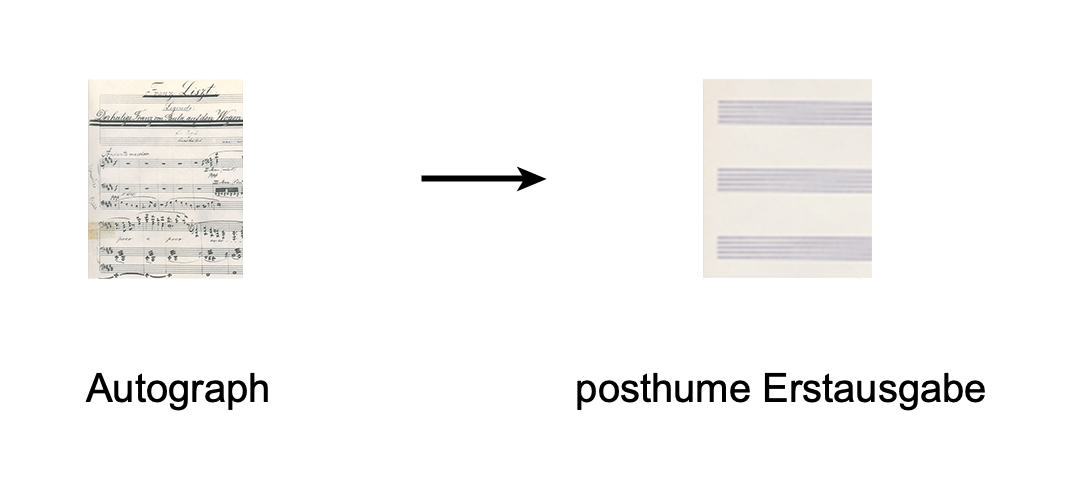
2. Quellenbewertung
Der Edition liegt als Leitquelle das Autograph zugrunde. In Zweifelsfällen wurde eine Titelauflage der Erstausgabe des Originalwerks zu Rate gezogen.
3. Sources
- Autograph
- posthume Erstausgabe
Object reference
Max Reger: Legend “St. Francis of Paola walking upon the waves” Liszt‑B1, in: Reger-Werkausgabe, www.reger-werkausgabe.de/mri_work_01237.html, version 4.0, 2nd July 2026.
Information
This is an object entry from the RWA encyclopaedia. Links and references to other objects within the encyclopaedia are currently not all active. These will be successively activated.